Condo Records After a Director Resigns Safely
September 8, 2026
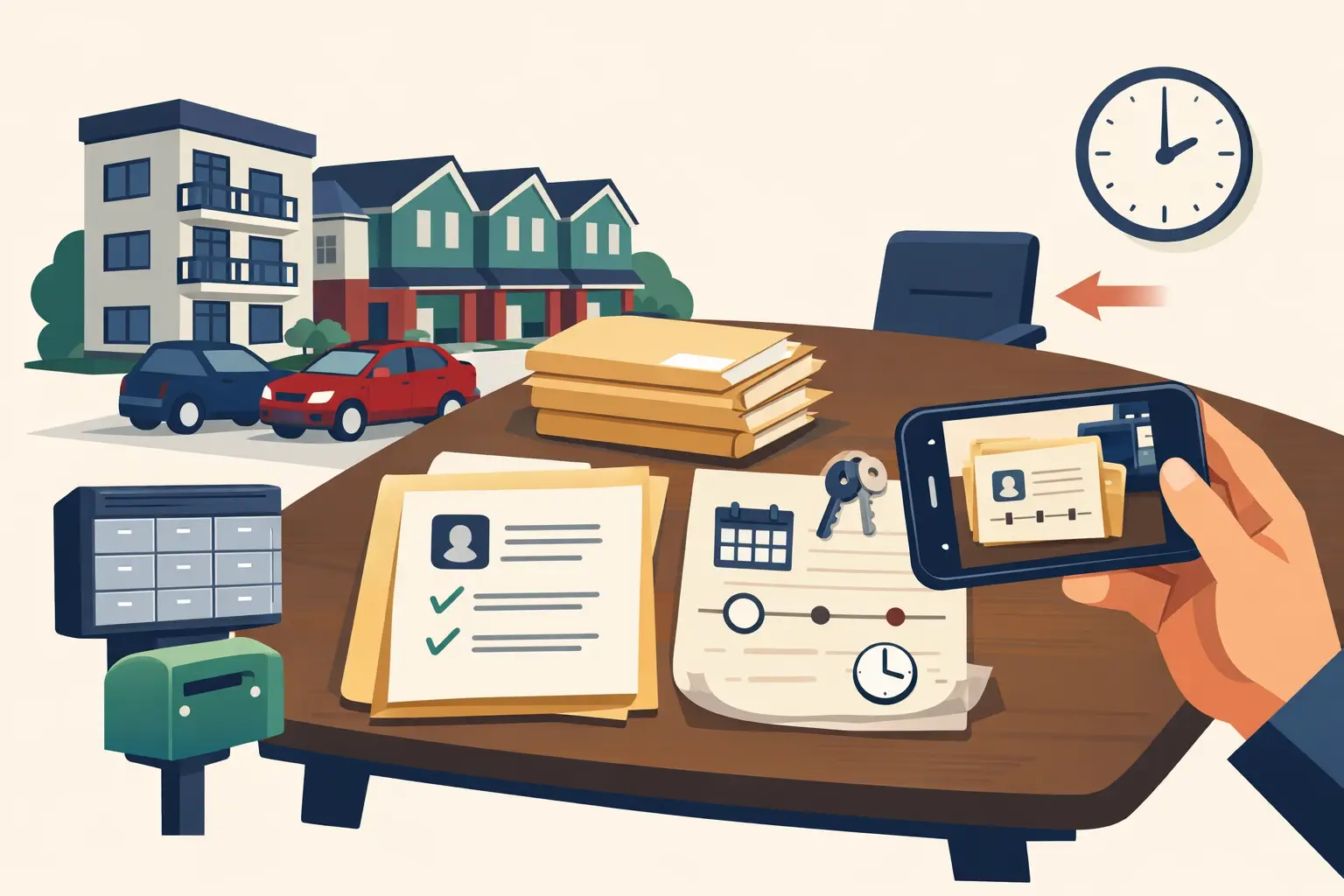
A director resigns on Monday. By Tuesday, the board learns that the compliance photos, draft letters and the only copy of last year's meeting minutes are in that director's personal Gmail account. Nobody is alleging bad faith. The problem is simpler and more common: volunteer boards often build the corporation's record inside personal inboxes, mobile phones and shared folders that only one person can reach.
Condo records after a director resigns should remain with the corporation, organised enough that the remaining board can answer an owner, respond to a records request or continue an open compliance matter without reconstructing months of work. A prompt, respectful handover protects the departing director as much as it protects the board.
Start with this director handover request
Send a short written request while the resignation is fresh. It avoids uncertainty about what the board needs and creates a record that the corporation acted promptly.
> Subject: Corporation records and access handover > > Thank you for your service as a director. To maintain the corporation's records and allow the remaining directors to continue current work, please provide or transfer any corporation materials in your possession by [date]. > > This includes board minutes and agendas, compliance correspondence and delivery records, owner communications, photographs, contractor reports, passwords or administrator access for corporation accounts, and files relating to open matters. > > Please do not delete corporation material from personal devices or accounts until the board confirms that the transfer is complete. If you prefer, the secretary can arrange a secure folder for upload or a time to collect paper files. > > The corporation will confirm receipt and remove your access to corporation systems once the handover is complete. Thank you again for helping preserve a complete board record.
Keep the tone factual. A resignation can be contentious, but an accusatory message often makes a practical task harder. If there is a concern about missing information, record that concern in the board's minutes and take advice appropriate to the circumstances.
What belongs in the corporation's file?
The useful question is not simply, “What did the former director create?” It is, “What does the corporation need to carry out its duties and explain its decisions?”
Under section 17(3) of Ontario's Condominium Act, 1998, directors and officers have a duty to act honestly and in good faith, and to exercise the care, diligence and skill that a reasonably prudent person would exercise in comparable circumstances. A usable corporate record supports that work. It lets the current board see what was decided, what notice was given and what remains outstanding.
Section 55 addresses the corporation's records and owners' rights to inspect or obtain certain records. Not every informal message is necessarily a section 55 record, and some material may contain personal information or require careful handling. But meeting minutes, notices, financial and governance records, executed agreements, formal correspondence and the documents supporting board decisions should not be stranded in an individual's account.
For a small self-managed corporation, use this inventory before disabling access:
- Board minutes, agendas, resolutions, meeting packs and attendance records.
- The declaration, by-laws, rules, insurance documents, major contracts and current contact lists.
- Owner notices, compliance letters, photographs, delivery evidence, responses and open escalation timelines.
- Login and administrator details for the corporation email, cloud storage, website, banking-related contacts and any board software.
- Paper binders, USB drives, personal mobile phone photos, WhatsApp exports and files saved on a home computer.
The last item is frequently missed. A director may have photographed a parking or noise issue on a mobile phone, discussed the next step in WhatsApp, and drafted the letter in a personal Word folder. Each piece is incomplete on its own. Together, they may explain why the board acted as it did.
Separate access removal from record recovery
A departing director should not retain active access simply because the board is still collecting files. But do not remove access first and discover afterwards that the director was the only administrator of a corporation email address or cloud folder.
Identify all accounts, appoint a remaining director as administrator, reset passwords and activate multi-factor authentication using a corporation-controlled email address or telephone number. Then remove the former director's access once the transfer is verified. Record the date, the person who completed each step and any account that still needs attention.
This is also the moment to stop using personal accounts as the permanent filing system. Personal email is convenient when a board is busy. It is less convenient when an owner says they never received a compliance letter, a new director asks why a matter was closed, or the Condominium Authority Tribunal asks for the history behind a dispute.
Preserve open compliance matters in order
An incomplete file is most damaging when the corporation is enforcing its declaration, by-laws or rules. The board needs more than a final letter. It needs the chronology: the observed issue, the date and location, the notice sent, proof of delivery, the owner's response, extensions granted, board decisions and any follow-up.
For conduct or activity that may be contrary to section 117, or use of a unit that may raise section 119, keep the relevant evidence with the correspondence. Section 117 addresses activities likely to damage property or cause injury or illness. Section 119 requires occupants to comply with the Act, declaration, by-laws and rules. The exact obligation and remedy will depend on the facts and on the corporation's governing documents.
Avoid trying to fill gaps from memory. If the former director recalls a telephone call but there is no contemporaneous note, record it as a later recollection and identify who recorded it and when. Do not backdate notes or edit old correspondence to make the file appear more complete. A straightforward gap is easier to explain than a chronology that does not hold together.
Where the declaration contains indemnification provisions, the board may need a record of costs and notices if it is considering cost recovery. Ontario condominium corporations cannot levy fines. That distinction matters in both the letter and the supporting file.
Make the handover a board action, not one person's task
The secretary often becomes the default custodian, but the whole board should know where the record is kept. Put the handover on the next board agenda and minute four things: the resignation date, the person responsible for collecting records, the systems being transferred and the target completion date.
Then ask a second director to review the inventory. This is not mistrust. It is a simple control for a volunteer board. One person may believe a folder is complete because it contains the final letters; another may notice that the delivery confirmations or owner responses are absent.
If the corporation has records requests under section 55, a pending CAT matter, or a dispute that could require an application under section 134, flag those files first. They deserve a defined custodian and a clear folder structure before routine archives. A board should also preserve the source material for any active matter rather than forwarding selected excerpts through new email chains.
Build the next handover before it is needed
The better file usually wins because it can be understood by someone who was not present. That does not require enterprise property-management software or a complicated document taxonomy. It requires one corporation-controlled location, consistent names for files, a record of delivery and decisions, and an agreed rule that board business is filed there.
YardRule is designed for self-managed Ontario corporations with up to 100 units: photos can be captured with GPS and timestamps, notices and owner responses stay with the matter, delivery is tracked, and the history is append-only rather than editable inside the app. It also produces board meeting packs and escalation reminders, so an open file does not depend on one director's calendar. Pricing is $49 per month for up to 25 units, or $99 per month for up to 100 units, with a 30-day full-product pilot and no credit card. If the corporation stops paying, its record remains readable and exportable.
Whether the board uses software or a carefully managed shared folder, test the system once a year. Ask a director who was not involved in a recent matter to locate the notice, evidence, delivery record, response and final decision. If that takes an evening of searching, the handover process needs work.
A director's resignation should mark a change in volunteers, not the disappearance of the corporation's memory. Keep the handover respectful, make the checks visible in the minutes and leave the next board a record ready before anyone asks for it.
This guide is general information, not legal advice; the corporation's declaration and its counsel govern.
This article is general information, not legal advice (Ontario law as of August 2026). Your corporation’s declaration and its counsel govern; confirm specifics with a condo lawyer or the Condominium Authority of Ontario.
Put the record behind your next letter
YardRule keeps the photo, the letter as sent, and the delivery record on one dated timeline for self-managed Ontario condo boards. $49/month for up to 25 units. 30-day pilot, no credit card; the record stays readable if you stop.